Please ensure Javascript is enabled for purposes of website accessibility Mastering Focus Groups in Customer-Centric Decision-Making | Revuze
Back to all reports

Mastering Focus Groups in Customer-Centric Decision-Making

    Inside You'll Find
  • Packaging Innovation Drives Engagement
  • Hair Loss Solutions Are Gaining Momentum
  • Hydration and Smoothness Are Essential Benefits

Introduction

In today’s hyper-connected and rapidly evolving business landscape, understanding customer sentiment and market demands is paramount to driving strategic decision-making, fostering brand loyalty, and staying ahead of the competition.


As organizations navigate changing market dynamics and shifting consumer preferences, the need for actionable insights and a nuanced understanding of customer behaviors has never been more critical.

Key to consumer-centric decision-making lies the utilization of a variety of research methodologies designed to uncover latent insights, explore emerging trends, and illuminate the underlying motivations that drive consumer behaviors.

Among the myriad of research methodologies available, focus groups are a commonly-used tool for gathering qualitative insights, fostering dialogue, and uncovering nuances within diverse market segments.

This whitepaper serves as a comprehensive exploration of focus groups as a research methodology, delving into their definition, purpose, advantages, limitations, and best practices for effective implementation. By providing an understanding of focus groups and their role within the broader landscape of market research, organizations can unlock the transformative potential of qualitative insights, drive innovation, and cultivate enduring customer relationships in today’s competitive business environment.

Mastering Focus Groups

Understanding Focus Groups

Originating in the aftermath of World War II within the domain of behavioral science research, focus groups evolved as a qualitative research methodology. Over the past century, their utilization expanded notably, particularly within the realm of qualitative marketing studies.

As noted by Brigit Kellmereit, focus groups gained substantial traction over the last 50 years, with over 250 thousand sessions conducted annually in the United States alone.
The essence of focus groups lies in their capacity to facilitate interactive discussions among participants, providing researchers and businesses with valuable qualitative data and nuanced perspectives.

In the words of George Kamberelis and Greg Dimitriadis:

“Focus groups are collective conversations or group interviews. They can be small or large, directed or nondirected.
The primary purpose of focus groups encompasses exploring attitudes, perceptions, preferences, and motivations underlying consumer behaviors. By fostering an environment conducive to open dialogue and exchange, focus groups enable researchers to delve beyond surface-level responses and unravel deeper insights into consumer mindsets.”

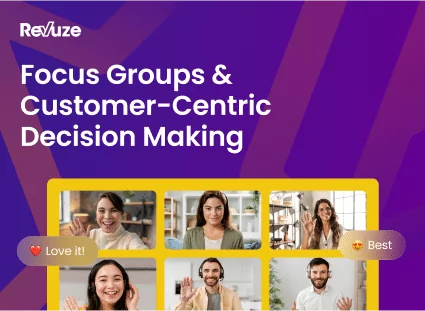
Online focus group

Types of Focus Groups

The traditional focus group includes anywhere from five to 20 participants, and is conducted in a controlled environment facilitated by a trained moderator who guides the discussion, prompts participants with open-ended questions, and encourages active engagement among attendees. Below, we explore other types of focus groups.


Mini Groups

Mini groups deviate from the conventional structure of focus groups by comprising only four or five participants, offering a more intimate setting for discussions. This smaller scale often fosters increased participant engagement and depth of conversation.

Online Groups

The advent of technology has ushered in a new era of focus group dynamics through online platforms. Remote-operated discussions utilizing video chat platforms transcend geographical boundaries, enabling researchers to engage with diverse participant demographics conveniently.

Two-Way Groups

Two-way groups introduce an intriguing dynamic where one group observes another, contributing to a layered discussion. Participants not only engage in dialogue but also offer commentary and insights based on observations, enriching the depth of the discourse.


Dual Moderator Groups

In dual moderator groups, the traditional role of a single moderator expands to incorporate two facilitators. While one moderator guides the discussion, the other assumes the responsibility of documenting insights and observations, ensuring comprehensive data capture.

Client Participant Groups

Client participant groups feature representatives of the business actively participating or observing the group discussion. This firsthand engagement provides stakeholders with direct exposure to consumer sentiments and facilitates informed decision-making aligned with organizational objectives.

Unlock the Full Report

Explore the advantages of focus groups and enhancements to this method

Key Objectives

Time Period
Date
April 2024

Uncover More Reports

Dedicated Action Hubs

Research and Take Action

Product Hub

AI-Powered Actions for Smarter Product Development
Explore ProductHub

Marketing Hub

Redefine your marketing strategy with generative AI-driven actions
Explore MarketingHub

CI Hub

Get an instant AI-powered view of your entire Voice of Customer with a click of a button.
Explore CIHub

Ecomm Hub

Unlock Real-Time Recommendations and Actions Across Your Entire eCommerce Ecosystem
Explore EcommHub

Reporting Hub

Empower your business with accurate intelligence to drive brand or product success
Explore ReportingHub