Inflation’s Impact on the Cosmetics Industry: Uncover Consumer Behavior
Product Return Analysis
Discover why consumers are returning products and address issues quickly
Competitive Intelligence
See what competitors launch, how they’re rated, and where you stand.
Product Innovation
Use trending topics and insights to guide enhancements that align with market needs.
Product Health Score
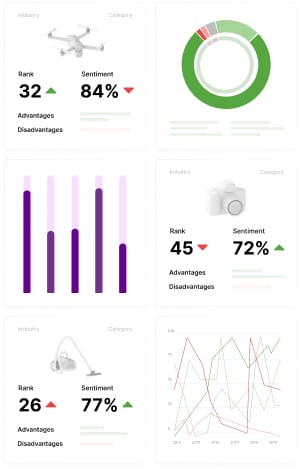
Measure a product’s performance within its category by analyzing sentiment, strengths & weaknesses
Product Launch Tracker
Monitor product launch performance, identify challenges & take action
Purchase Motivators
Identify what drives customers to choose your product over competitors
Trending Hashtags
Topics audiences are actively engaging with.
Category Launches
See new competitor launches entering the conversation.
Crisis Management
Early indicators of potential crises or reputation risk.
Video Analysis at Scale
See exactly how you stack up, and where you can outperform
Organic vs. Incentived
Evaluate organic vs. incentivized feedback. Distinguish between signals & noise.
Campaign Monitoring
Analyze your own social content.
SWOT Analysis
Identify product strengths, weaknesses, opportunities and threats using VoC.
360° of VOC
Leverage insights from multiple sources to get a full, unbiased perspective
Market Trend Analysis
Benchmark shift in consumer behavior using 24 months category-level data
Star rating drivers
Understand what influences customer ratings and take steps to improve them.
AI-powered surveys
Generate online surveys based on category benchmark data and distribute to millions of potential buyers
Unmet Needs
Identify consumer pain points and areas where demand is not being met.
PDP Enrichment
Enhance PDPs with embedded, AI-powered review summaries to improve customer trust and drive sales
Shopper Experience
Gain a 360° view of the online shopping journey to deliver a seamless experience
Price Tier Analysis
Benchmark product pricing across sales channels to identify correct price point
Competitive Intelligence
See what competitors launch, how they’re rated, and where you stand.
Trend Detection & Forecasting
See what’s coming before it’s everywhere
Influencer Discovery & Vetting
Work with creators who align with your brand
Visual Mention Tracking
Know where and how your brand appears, even when untagged
CX Pain Point Discovery via UGC
Fix what’s broken straight from the customer’s point of view
Crisis Detection & Virality Monitoring
Catch backlash before it explodes or amplify a breakout hit
Customer Satisfaction
Understand what’s driving satisfaction or friction
Usage & Attitude (U&A)
Explore how people use your product and how they feel about it
Market Segmentation
Better understand your audience segments
Concept Testing
Test new product ideas before you launch
Messaging & Claims Testing
Validate product claims and messaging strategies
Brand Tracking & Positioning
Monitor your brand’s health in real time
Automated Onboarding
Speed up the onboarding process, improving the entire customer experience across channels.
Centralize Engagement Data
From conversations to insights to revenue across all channels
Convert Visitors into Buyers
Interactive chatbots engage visitors and drive sales
Full Attention to Every Customer
Automatically route all customer conversations to one unified inbox
Product sales & revenue data
Track performance across 100M+ products, by engagement, revenue, units sold, MoM growth, and more.
Top trending categories
Size opportunities by capturing rising categories as they emerge to align product assortments with demand.
Shop & competitor insights
Unlock new products in your category and learn sales data across the entire competitive landscape.
Video analysis at scale
Analyze at scale to see which formats, messages, and creators directly spark sales.
Instantly access actionable VoC insights based on buyers’ post-purchase feedback
During the past year, inflation and prices soared while wages remained mostly flat, affecting how consumers shop. We were curious to understand how these changes affected consumers’ shopping behavior, so we took a deep dive into data from the beauty and cosmetics industry.
Interestingly, we found fascinating relations between inflation and what it means for consumers when they shop. Read on to discover how consumers reacted, what it means for your brand, and how to position yourself in this new market.
In this original research study, we’ve examined how these circumstances have affected consumer behavior, specifically within the beauty and cosmetics ecommerce industry.
We collected and analyzed over 125,000 online reviews of cosmetic products from major online retailers, including:
Our analysis focused on the first three quarters of 2022. While we have data for Q4, we decided not to include it in our analysis as the holiday season can easily skew the data. Product categories we looked into include:
In the next section, we’ll explore strong positive and negative correlations between inflation rates and beauty products sentiment. A positive correlation tells us customers are delighted with the price/ VFM these products offer, while a negative one tells us the opposite.
![]() |
![]() |
Discover how inflation influencing shoppers purchasing behavior around cosmetics
![]() |
![]() |
![]() |
![]() |
![]() |
![]() |
![]() |
![]() |
In the next section, we’ll explore strong positive correlations between inflation rates and beauty products volume review. Such positive correlations tell us customers discuss price/VFM topics in accordance with inflation rates movement.
When talking sentiment, we’re witnessing strong positive correlations between various DIY products, such as eye, nail, and face kits, and inflation.
This means that as inflation went up, people felt much more satisfied when buying these kinds of products, especially in terms of their pricing and value for money they offer.
On the other hand, we saw a strong negative correlation between Foundation products and inflation, meaning consumers felt dissatisfied with these products as the value for money wasn’t there.
Finally, seeing the overall strong positive correlation between volume and inflation says a lot. As inflation soars, consumers mention price and VFM more and more in their reviews, indicating these factors are of interest to them when leaving reviews and possibly when deciding which items to purchase.
Let’s discuss what it means for you.
The beauty industry is unique in that it is not impacted by inflation like other consumer products. Indeed, cosmetic prices have been at their highest since 2016, yet sales are generally increasing, not decreasing.
Coty Inc., one of the world’s biggest beauty companies, reported a growth of 9% in organic sales in Q3 2022. L’Oréal reported a sales increase of the same size. Low-cost drugstore makeup company E.l.f. Beauty reported an even-more impressive 33% rise in sales.
This reflects the cosmetics industry’s general hardiness in times of economic downturn. Consumers don’t show a tendency to stop buying cosmetics as their budgets tighten. But our report does note that feelings changed, as DIY kits are perceived as worthy products, while others are less so.
What we see can be explained as an extension of the DIY trend that emerged due to the COVID-19 pandemic, as consumers could not visit salons and spas. This time, inflation provided yet another reason to do one’s nails, lashes, and makeup in the comfort of their home.
It is also important to note that consumers are highly aware of inflation and increasing prices. They explicitly name pricing and value for money in product reviews, which means they see these as essential considerations for buying decisions.
For you, it means you must remember consumers are price-conscious. It doesn’t necessarily mean they won’t buy luxury items, but they expect – more so than at other times – that your product will be worthy of the price of admission, providing them the bang for the buck they’re after. If they don’t find it with you, they’ll look elsewhere.
Knowing how consumer behavior changes and what affects it can inform everything from pricing to product development to marketing. Staying curious and connected to data is the best way to stay caught up.
Retailers cannot simply go on with business as usual. As consumers’ lives and budgets are changing, so are their needs. Companies that want to hold on to market share and maintain a competitive advantage must stay on top of what is happening, committing to an ongoing practice of data-based industry analysis.
Businesses must collect and analyze data to make informed, data-driven decisions. Among other sources, online reviews emerge as a crucial – and accessible – measure of customer experience, satisfaction, and needs.
Making sense of this data will help you understand what consumers are after. Not just with your product but in the entire market, ensuring you’ll get the competitive edge you need.
Nowadays, with changes lurking behind every corner, getting a hold of your data is more critical than ever.
Revuze works with Fortune 500 companies and brands worldwide to provide valuable insights into consumer analytics. Revuze’s powerful AI can analyze online customer reviews and other user-generated data in any industry.
It can then detect industry-specific lingo and sentiment expressions to help companies learn about their customers, their competition, and new market trends.
It’s all in real-time, with easy-to-read reports, and minimal hassle.