 All
Articles
All
Articles Email
Analytics
Email
Analytics

Boaz Grinvald


There might be only one thing different business owners and service providers can agree on: Knowing how to measure customer satisfaction is crucial for keeping your business growing. The customers are the key element of every business and keeping them happy means keeping the business alive.
Over the years, many studies have shown the importance of customer satisfaction, how crucial it is to gain the correct data about it, and why many businesses fail by not doing so.
The main issue is the complexity of conducting such research and of gaining accurate, actionable data regarding your customers’ satisfaction.
This is the question we will answer in this article, providing you a simple and tested method of gathering this data and acting upon it.
There are two main types of overall satisfaction measurements – Customer Satisfaction Score (CNAT) and Net Promoter Score (NPS)
What is Customer Satisfaction Score (CSAT)?
Customer Satisfaction Score (CSAT) is a score that measures the satisfaction customers had with a certain process or interaction.
This is measured multiple times during the customers’ experience and each measurement provides you with the understanding of how satisfied your customers are with this experience. It is important to understand, we are talking about a certain experience (The shipping process, how was the service the online chat representative provided, how is the product itself, etc).
You can choose between different measurement methods, though we would recommend the standard Happy Customer Percentage measurement.
How to conduct a happy customer percentage survey?
This is rather simple. First, we need to ask our customers, for a specific experience they had, how did they feel about their experience, between 1 to 5:
- Very Unhappy / Dissatisfied
- Rather Unhappy / Dissatisfied
- Neutral
- Happy / Satisfied
- Very Happy / Satisfied
We then use the following formula:

When the satisfied customers are those who answered 4-5 in the survey.
For measuring the overall satisfaction and the perception a customer has for your company, you should use a Net promoter Score (NPS). We will cover this subject in an upcoming post.
Many confuse between Net Promoter Score (NPS) and Customer Satisfaction Score (CSAT), so let’s first make the terms clear.
What is Net promoter score?
Net Promoter Score (NPS) is a way to measure the long-term loyalty a customer has to a brand or company.
It is measured using an index ranging between -100 to 100 points and is used to predict how likely a customer will promote your product, service or brand.
What are the differences between CSAT and NPS?
Both CSAT score and NPS survey are types of feedback surveys that allow you to know if you are handling your customers in the way they are expecting. The key point to remember here, is that CSAT score is measured multiple times during your customers’ interaction with your brand, and NPS is measured once, on the final stage of the interaction (for example, after the goods are supplied). Both are extremely important and they complement each other.
We will cover Net Promoters Score in the following articles. CSAT might sound more complex to conduct, but actually it is fairly simple.
When should I measure the Customer Satisfaction Score?
As mentioned, this measurement should take place in a few of the key points of your customers’ interaction with your company or brand.
The key here is to find the magic number between too few and too many measurement points. Too few measurement points will not give us enough data and we might miss a critical feedback point that makes us lose customers constantly.
Let’s say for example, that we have an online product that is automatically sent by a Chinese factory to our customer. The factory receives the order details from our website upon order and sends the product using Hongkong post.
All fine until here, but let’s say one of the programmers has made a mistake and all phone numbers are printed without the country code. Some of the customers then cannot be contacted by the delivery person and their parcels are left near their doorstep, which might disappoint them.
These customers will never order from us again .Can you see the importance in this case, of gathering the customers’ experience for the shipping of our product specifically?
On the other hand, too many customer surveys are a problem by themselves, causing customers to leave false feedback (just to get on with the process), not to leave feedback at all, or worse – to be irritated by the whole feedbacking system and stop interacting with our business.
There is no one solution or formula for this, for it depends a lot on the type of customers, the type of the product and the length of the interaction.
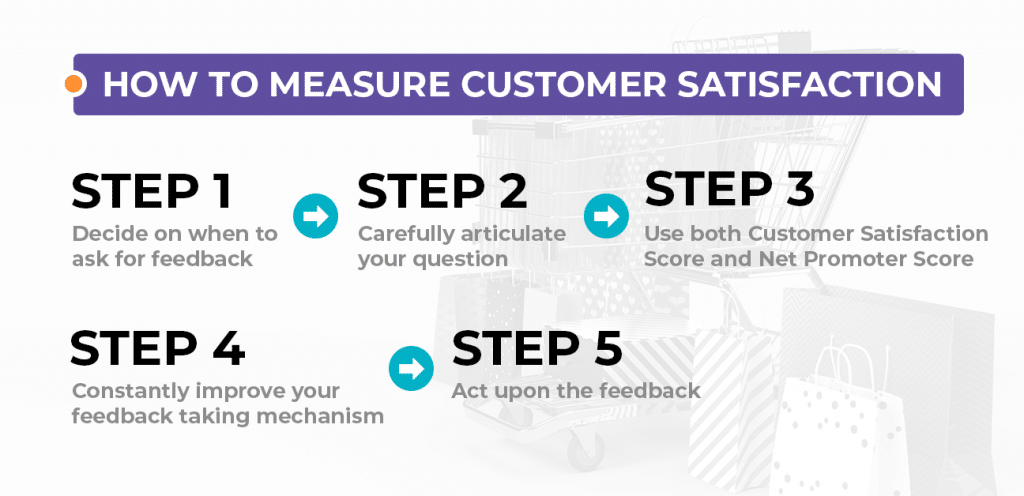
So, what are the steps to measure our customer satisfaction?
How to measure customer satisfaction
- Step 1: Decide on when to ask for feedback.
As mentioned above, there is a magic spot between asking for too much feedback and not asking for enough feedback. Choose wisely and try to adjust these data collection points along the way.
- Step 2: Carefully articulate your question.
Make sure that the question you ask your customers at each point is very specific and accurate. You want to avoid any misunderstanding of what you are surveying them for.
- Step 3: Use both Customer Satisfaction Score and Net Promoter Score.
This article is mainly about CSAT, though it is equally important to measure the overall satisfaction of our customers by conducting an NPS survey too. The more data you have, the better your customer service will be.
- Step 4: Constantly improve your feedback taking mechanism.
It’s important to regularly examine the methods and the times when you interact with your customers (Especially with CSAT where this is not specifically defined) and improve it over time. If the feedback causes too much hustle for your customers, find ways to reduce the time they need to invest in it and the number of times you ask for feedback. On the other hand, if you see that there are some customers that are unsatisfied but have not given a specific feedback at one of your survey points, find a way to ask for this data in the future.
- Step 5: Act upon the feedback.
This is the most important point, and the one that many businesses fail to apply. When you find that there is something that needs to be improved for your customers’ overall satisfaction, IMPROVE IT. I hope there is no need to explain why this is the most important step. Not acting upon the feedback you have received is similar to not taking feedback at all, and since you are reading this article, I guess you understand the importance of your customers’ satisfaction.
2 Important tips for better feedback from your customers:
Before we summarize, there are 2 tips that will help you understand your customers better.
- Make sure your questions, when taking feedback, are clear and is not ambivalent. This way when a customer leaves feedback, you will know the exact experience they are referencing.
- Add a comment box for further notes.
Sometimes a scale is just not enough and you would want to understand EXACTLY HOW you could improve a certain experience. A free-text comment box might give you wonderful insights.
Conclusion
Customer feedback is critical. You want your customers to return and to bring their friends and relatives too. Make sure you understand how satisfied they are and keep in mind that whenever you think there might be a problem, there probably is. Act upon rising problems as quickly as possible to make sure the name of your brand is mentioned with joy and spread by word of mouth.
Good luck!
(And feel free to give your feedback ☺)




 Agencies
Insights
Agencies
Insights