Customer Intercept Survey – Everything You Wanted To Know

Customer Intercept Survey – Everything You Wanted To Know

Wouldn’t it be nice to know what consumers are thinking about different points of their interaction with your brand? True, there are a lot of ways to conduct market or customer experience research, but one of the most direct and fast ways is the customer intercept survey.

In this article, we will explain what customer intercept surveys are, give you some examples, and talk about the advantages and disadvantages of using this popular research tool.

What Is a Customer Intercept Survey?

Simply put, a customer intercept is talking to people while they are engaged with a service or product. It is a qualitative market research method that provides valuable insights into what’s working, current consumer pain points, and emotional motivators that drive decision-making.

Customer intercept surveys are a popular tool for gathering on-site feedback from consumers. Traditionally, these surveys were held at restaurants, conferences, and shopping malls, but have since transitioned to digital intercept sites such as eCommerce platforms, mobile apps, and social channels.

Online intercept surveys come in varied forms, depending on your data collection goals and the survey solution you choose.

Whichever form you choose, eCommerce consumer intercept surveys are a powerful tool, as they help you understand customers’ behavior and intent, providing priceless insight into how they experience your brand. These insights can be leveraged into actionable goals for marketing, sales, product innovation, and CX optimization.

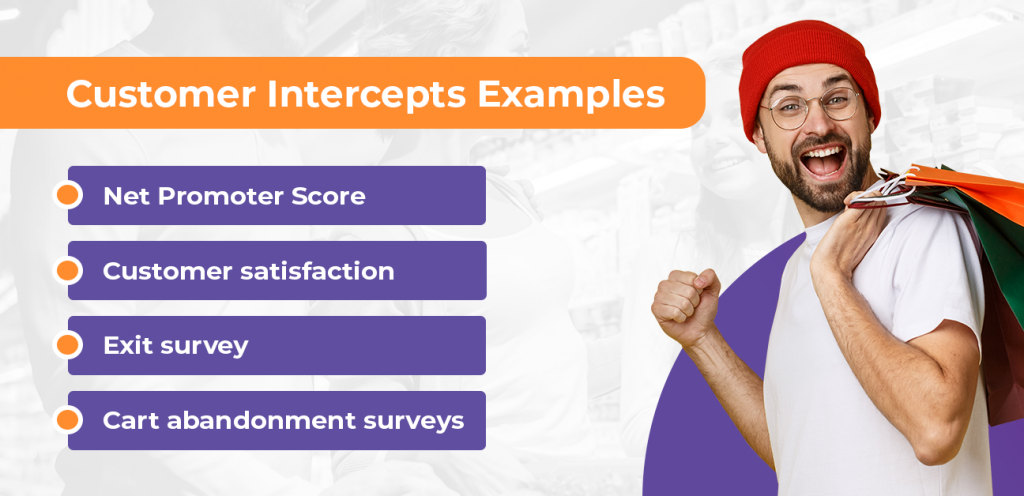
Customer Intercept Examples

Let’s review some examples of intercept surveys commonly used on websites and online applications.

  • Net Promoter Score (NPS) — Ask consumers if they would recommend your product/site/service, aiming to measure their loyalty.

  • Customer Satisfaction (CSAT) — Ask how satisfied they were with their last purchase, your site layout/content, or customer service.

  • Exit Surveys — Ask consumers why they’re leaving before they do so.

  • Cart Abandonment Surveys — Ask why they’re not going through with a purchase.

  • Intercept Interviews — Instead of quick multiple-choice surveys, brands can conduct short one-on-one intercept interviews via chat or phone to understand sentiment in real time.

  • Intercept Calls — Many companies now combine website intercepts with follow-up calls for deeper feedback, a hybrid model that blends qualitative insights with measurable data.

Intercept Survey Questions

So what questions should you use in your intercept survey? 

Here are some typical examples:

  • What services/products did you purchase or use today?

  • What was the main reason for your visit today?

  • How likely are you to recommend this product/service to a friend, family member, or colleague?

  • How did you find this location, website, or service?

  • How often do you visit this location or website?

  • How would you rate your satisfaction or experience today?

  • Did you achieve your goal or find what you were looking for?

Intercept Survey Advantages and Disadvantages

Like any method, intercept surveys have both advantages and drawbacks.

Advantages:

  • Versatility with placement, format, and target audience.

  • High response rates since you engage consumers at relevant touch points.

  • Accurate feedback collected close to the experience.

  • Wider demographic reach so anyone on your intercept site can respond.

  • Easy execution

Disadvantages:

  • Multiple steps can make them time-consuming.

  • They can be perceived as intrusive (e.g., pop-up windows).

  • To achieve reliable data, you need a high response volume or longer duration.

  • Respondents may represent extreme opinions rather than the average experience.

For organizations running multiple campaigns or channels, a Voice of Customer (VoC) Survey  program can help validate intercept findings with broader sentiment analysis and pattern recognition.

Intercept Survey Solutions

There are many different website intercept survey solutions you can set up yourself or via providers like SurveyLab. Among the popular methods are:

  • Pop-ups (Modal Boxes): appear anywhere throughout the customer journey.

  • On-page Widgets: small boxes in a site corner that allow voluntary feedback.

  • Website Tabs:  less intrusive than pop-ups but easy to ignore.

  • Exit Surveys: appear when the system detects a user is about to leave.

As CX research becomes more advanced, brands also integrate AI-based intercept logic that triggers questions based on behavior (ie. time on page, scroll depth, purchase intent). This contextualization increases completion rates while reducing interruption fatigue.

Beyond the Basics: TCSG Survey, Intercept Calls & Interviews

While intercept surveys have traditionally been simple website pop-ups, modern customer-first organizations are expanding them into multi-touch “TCSG” survey frameworks, short for Target, Capture, Segment, and Guide.

A tcsg survey is designed to capture contextual insights in real time, then segment and guide next-step engagement based on the respondent’s feedback. For example, if a customer reports low satisfaction, the system can automatically trigger a follow-up intercept call or offer a discount code to re-engage them.

Similarly, intercept interviews, short, conversational exchanges through chatbots or live agents, give researchers the ability to collect qualitative, story-based insights that traditional multiple-choice surveys miss. These are especially useful in customer experience consulting and Voice of Customer Analytics, where the “why” behind behavior matters as much as the “what.”

In omnichannel environments, intercept sites now extend beyond websites. Brands deploy feedback touch points in mobile apps, interactive kiosks, and even video platforms. Integrating these signals into broader Brand Health Tracking dashboards allows marketers to correlate real-time feedback with brand sentiment, campaign effectiveness, and product performance.

How Intercept Surveys Fit into Modern CX Strategy

To stay competitive, companies must combine traditional intercept feedback with AI-powered Voice of Customer Analytics that synthesize millions of data points from reviews, surveys, and social media.

Unlike one-off surveys, this integrated approach helps brands see the bigger picture — uncovering hidden drivers of satisfaction, friction points, and emerging trends that manual research would miss.

This is especially relevant given that traditional surveys often fall short of the modern consumer data challenge. As discussed in 5 Reasons Why Surveys Aren’t Up to the Consumer Data Challenge, most companies still struggle with limited sample sizes, response bias, and slow turnaround times. Intercept data fills part of that gap, but true CX intelligence comes from merging intercepts with broader VoC analytics.

Best Practices for Maximizing Intercept Effectiveness

To make your intercept initiatives successful, follow these best practices:

  1. Select the right trigger: Time the intercept carefully to match intent (e.g., after a purchase, during checkout hesitation, or post-support interaction).

  2. Keep it short: Aim for fewer than five questions to avoid abandonment.

  3. Personalize dynamically: Use previous responses or behavior to adjust the next question in real time.

  4. Include qualitative touch points: Combine surveys with optional intercept interviews or intercept calls to capture richer insights.

  5. Integrate with analytics: Feed responses into a centralized CX platform for cross-analysis with other data sources.

  6. Monitor continuously: Use ongoing intercept programs rather than one-time campaigns to track evolving consumer sentiment.

The Bigger Picture: From Intercept to Insight

Customer intercept surveys offer brands a direct line to consumers — but they’re only one piece of a much larger CX puzzle. To truly understand your customers, you need an always-on feedback ecosystem that integrates intercept responses, social listening, online reviews, and operational data.

That’s where Customer Experience Consulting and AI-driven analytics platforms like Revuze come in. They help translate fragmented intercept data into meaningful action, surfacing opportunities for product improvement, campaign optimization, and customer loyalty growth.

In Conclusion

Customer intercept surveys remain one of the most efficient and immediate tools for gathering on-site feedback from consumers. They provide valuable data about how users experience your brand, products, and digital touch points.

However, these surveys can sometimes be narrow in scope. To avoid missing valuable insights, combine intercept methods, including tcsg surveys, intercept sites, intercept interviews, and intercept calls, with larger Voice of Customer (VoC) and analytics frameworks.

Incorporating technologies like Voice of Customer Analytics ensures your brand captures the full emotional and experiential landscape of your consumers.

Ultimately, the future of intercept surveys isn’t just about asking questions,  it’s about connecting every answer to action.

FAQs 

1. What is the difference between intercept surveys and traditional online surveys?
Intercept surveys capture feedback in real time while customers are interacting with your site or product, offering immediate context. Traditional online surveys are typically sent later via email, focusing on retrospective opinions rather than live behavioral insights.

2. How can I increase response rates for on-site intercept surveys?
Keep surveys short and relevant, trigger them contextually (e.g., after purchase or on exit), and offer small incentives. A clean, mobile-friendly interface and minimal disruption ensure higher completion rates without compromising user experience.

3. Are intercept surveys GDPR-compliant?
Yes, as long as you inform users about data collection, store responses securely, and allow opt-out options. Partnering with trusted platforms that comply with GDPR standards ensures all personal information remains protected and anonymized.

4. What tools help automate intercept calls or pop-ups?
AI-driven platforms and customer experience tools like Revuze automate intercept pop-ups, chat triggers, and follow-up calls based on user behavior. These tools help collect insights efficiently while minimizing manual setup or intrusive disruptions.

5. Can AI improve the analysis of intercept survey responses?
Absolutely. AI and Voice of Customer Analytics platforms automatically classify open-text feedback, identify sentiment trends, and reveal hidden patterns, helping brands translate raw intercept data into clear, actionable insights faster than manual analysis ever could.

Simone Somekh
More posts from this author